Looking for Yardi Alternatives for Acquisitions Underwriting?
Teams searching for Yardi alternatives for deal analysis are looking for something Yardi was never built to provide. Yardi Voyager and Yardi Breeze are industry-leading property management and accounting platforms: they manage what you own. But the moment your acquisitions team tries to underwrite a new deal inside Yardi, they hit a wall: there is no OM ingestion, no assumption validation, no AI-powered underwriting, and no deal analysis workflow. Acquisition teams at Yardi shops underwrite in Excel, separately from Yardi, then feed closed deals back into the system.
AcquiOS AI closes that gap. It is the acquisitions underwriting layer that Yardi ignores entirely: forward a broker OM and get a fully validated underwriting model in minutes, with every assumption checked against market data and structural conflicts flagged before they reach your investment committee. No other Yardi alternative delivers this combination for the buy-side workflow.
Why This Comparison Matters
Yardi is one of the most widely deployed platforms in commercial real estate. If your firm runs Yardi, your property management, lease administration, accounting, and asset reporting all flow through it. It is a deeply entrenched system with a large install base and a proven track record for portfolio operations.
But Yardi was built for owners, not acquirers. The entire platform assumes you already own the assets. There is no workflow for evaluating whether to buy something in the first place. Your acquisitions team exists in a different universe from your Yardi environment: they are reading broker OMs, building Excel models, arguing about cap rate assumptions, and trying to decide which deals are worth pursuing. None of that happens in Yardi.
AcquiOS was built for exactly this gap. It is the pre-acquisition operating system that feeds into Yardi: not a replacement for it, but the analytical layer that should precede every asset entering your portfolio.
At a glance
The honest version, before the detail below. Both products are good at something; they are good at different things.
Many firms run both. Where the two overlap is narrower than either vendor's marketing suggests.
Quick Capability Comparison
| Capability | Yardi | AcquiOS |
|---|---|---|
| Property Management & Accounting | ✓ | ✗ |
| Lease Administration | ✓ | ✗ |
| Tenant & Lease Tracking | ✓ | ✗ |
| Portfolio Reporting & Budgeting | ✓ | ✗ |
| AI Underwriting (OM to Model) | ✗ | ✓ (90 sec) |
| Assumption Validation vs Market | ✗ | ✓ |
| Structural Conflict Detection | ✗ | ✓ |
| Rental Rate Verification | ✗ | ✓ |
| Acquisitions Pipeline Management | ✗ | ✓ |
| Due Diligence Project Management | ✗ | ✓ |
| Investment Memo & Deck Generation | ✗ | ✓ |
| Output to Your Excel Templates | ✗ | ✓ |
Detailed Feature Comparison
What Yardi Does Well
Yardi Voyager is the dominant enterprise platform for large-portfolio property management. Lease administration, tenant billing, maintenance tracking, accounting, and investor reporting all run through it. For operators managing hundreds or thousands of units across multiple asset classes, Yardi provides a single source of truth for everything that happens after acquisition. Its depth in accounting and compliance is unmatched in the market, and its install base spans some of the largest owners in commercial real estate.
Yardi Breeze serves smaller operators with a lighter-weight interface built on the same foundation. Both products reflect decades of investment in the post-acquisition workflow.
Where Yardi Stops
Yardi's boundary is the closing date. Everything before you own the asset: sourcing, screening, underwriting, due diligence: exists outside Yardi's domain. There is no offering memorandum ingestion. There is no AI underwriting. There is no mechanism for validating whether the broker's rent assumptions match market reality, or whether the proforma cap rate implies debt service coverage that is actually achievable. Yardi has no deal analysis capability because it was never designed as a buy-side tool.
The practical result: acquisition teams at Yardi shops build Excel models by hand, pulling numbers from OMs manually, running their own comps, and hoping nothing was missed. It is time-consuming, inconsistent across analysts, and leaves significant room for error before capital is committed.
AI Underwriting: Where AcquiOS Starts
AcquiOS begins where Yardi does not: at the broker OM. Forward an offering memorandum to AcquiOS and the platform extracts every assumption: purchase price, projected rents, vacancy rates, expense ratios, cap rates, debt terms: and builds a fully structured underwriting model in minutes. That model is then validated against market data: are the rent assumptions in line with recent lease comps? Is the exit cap rate realistic for this submarket? Is the debt coverage ratio mathematically achievable given the proposed terms?
Every assumption is cited back to its source. Every outlier is flagged. Every structural conflict is surfaced before it reaches your investment committee.
Assumption Validation and Market Intelligence
Yardi's analytics tools focus on your owned portfolio: actuals vs budget, rent trends across your assets, operating performance by property. This is valuable for asset management. It is not useful for evaluating a deal you do not yet own.
AcquiOS validates deal-level assumptions against market data before you commit. If a broker's proforma assumes 5% rent growth in a submarket averaging 2%, AcquiOS flags it. If vacancy assumptions are optimistic against the building's lease-up history, AcquiOS surfaces that. This is the validation layer that prevents expensive underwriting mistakes from making it to closing.
Acquisitions Pipeline Management
Yardi has no acquisitions pipeline. Deal sourcing and screening happen entirely outside the system: typically in email, spreadsheets, or whatever CRM an acquisitions team has bolted on. There is no structured workflow for moving a deal from inbound OM to screened opportunity to underwritten model to IC decision.
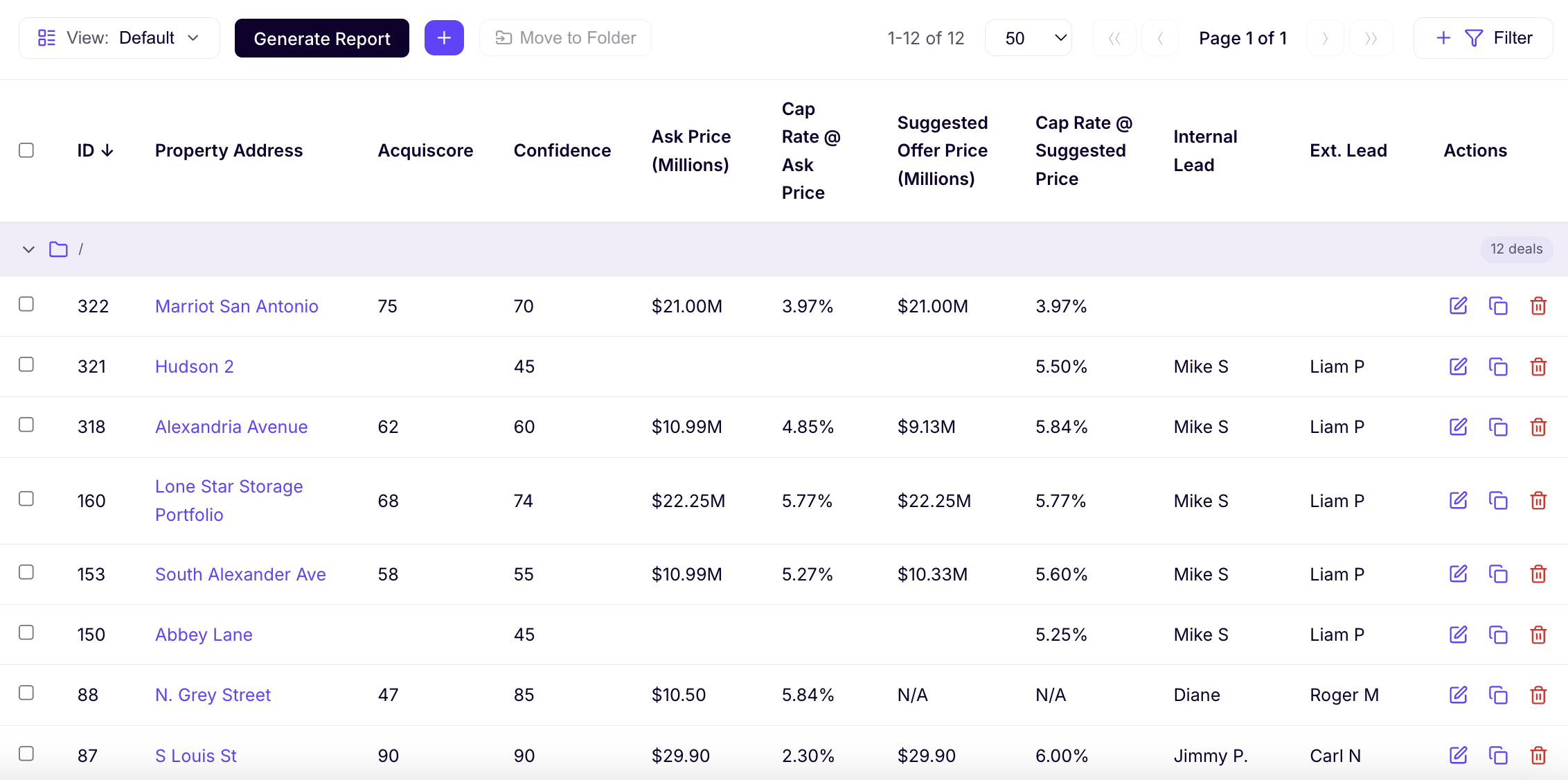
AcquiOS includes a full acquisitions pipeline built around the analysis workflow. Email a broker OM and AcquiOS automatically creates a pipeline entry, extracts the deal, runs underwriting, and scores the opportunity with AcquiScore (0-100) against your buy box. Every deal your team looks at is tracked, scored, and compared: creating consistency and institutional memory that spreadsheets cannot provide.
Template Preservation
One of the most common objections acquisitions teams have to any new software is being forced into a new model format. Your Excel underwriting template is tied to your LP reporting, your IC process, and your institutional memory of how deals are structured. Switching templates is expensive and disruptive.
AcquiOS learns your existing template and outputs model results into that exact format. The AI does the analysis; you get the output in the format your process already expects. Yardi has no equivalent: Yardi outputs live in Yardi's system, not in your templates.
Due Diligence and Investment Memos
Once a deal passes initial underwriting, AcquiOS provides due diligence project management to coordinate document requests, track third-party reports, and maintain a single source of truth through the DD process. When IC-ready materials are needed, AcquiOS generates investment memos and decks in your PowerPoint template. Yardi has no equivalent for either of these pre-ownership workflows.
Pricing and Complexity
Yardi Voyager is enterprise-only with implementation timelines measured in months and total cost of ownership that typically reaches six figures before annual licensing. It is built for organizations that need its full depth and are willing to invest in configuration and training to extract it.
AcquiOS Growth starts at $999/month for up to 20 deals per month on one template. Enterprise covers up to 300 deals per month on three templates. Most teams are productive within hours, not months, because AcquiOS works with your existing process rather than replacing it.
Why Acquisitions Teams Add AcquiOS to Their Yardi Stack
Teams using AcquiOS report an average 92% reduction in underwriting time per deal. Source: AcquiOS customer data, 2025–2026.
The Real Answer: They Solve Different Problems at Different Stages
Yardi is the right tool for managing a portfolio. AcquiOS is the right tool for building one. These are not competing decisions: they are sequential ones. AcquiOS operates in the pre-acquisition workflow: sourcing, screening, underwriting, due diligence, and IC. Yardi operates in the post-acquisition workflow: operations, accounting, tenant management, and reporting. If your firm does both, you need both. The question is not which one to choose; it is whether your acquisitions team has the right tool for the part of the process Yardi does not cover.
Most Yardi shops today are underwriting in Excel. AcquiOS replaces that manual Excel workflow with AI-native underwriting that is more consistent and validated against live market data. The output still goes to your templates. Closed deals still go into Yardi. The only thing that changes is the hours your team wastes on repetitive modeling work.
Frequently Asked Questions
No. AcquiOS and Yardi solve fundamentally different problems. Yardi manages properties you already own: tracking leases, tenants, accounting, and asset performance. AcquiOS underwrites properties before you acquire them. Most acquisition teams at Yardi shops add AcquiOS to handle the deal analysis that Yardi was never built to do.
Yes, and this is the most common pattern. AcquiOS handles pre-acquisition underwriting: converting OMs to models, validating assumptions, detecting conflicts, and generating IC-ready outputs. Once a deal closes, it moves into Yardi for ongoing portfolio management. AcquiOS fills the analysis gap before deals enter the Yardi ecosystem.
Minimal. If you know how to read a broker OM and use Excel, you know how to use AcquiOS. Forward a broker email to the platform and it generates the model and analysis. Most teams are productive in a few hours, not weeks. There is no months-long implementation like a Yardi Voyager deployment.
We flag when assumptions are outliers, but we do not force a particular view. Your IP around off-market deals remains yours. AcquiOS helps you validate whether your rationale for off-market assumptions is sound; it does not override your investment thesis.
Yes. AcquiOS is SOC 2 certified with private cloud deployment options for enterprise customers. Your deal data stays in your segregated environment with RBAC, audit logs, and data segregation as standard. We have architected this specifically for institutional investors handling sensitive pre-acquisition deal information.
AcquiOS Growth starts at $999/month and covers up to 20 deals/month on 1 template. Enterprise covers up to 300 deals/month on 3 templates. Yardi Voyager is enterprise-only with implementation costs that typically run six figures before annual licensing. AcquiOS is focused specifically on acquisitions underwriting and priced for the deal volume teams actually run. Book a demo to compare for your specific situation.
Yardi is not an acquisitions underwriting tool, so finding a Yardi alternative for buy-side deal analysis means finding software Yardi never offered. AcquiOS is a leading AI-native platform for CRE acquisitions underwriting: it converts OMs to models in minutes, validates assumptions against market data, detects structural conflicts, and outputs to your existing Excel template. Other tools in the landscape include ARGUS for DCF modeling, and Dealpath or Altrio for pipeline management: but none combine AI underwriting with assumption validation the way AcquiOS does.
AcquiOS does not replace Yardi: it fills the gap Yardi leaves open. Yardi manages your portfolio after acquisition. AcquiOS underwrites deals before they enter the portfolio. Acquisitions teams at Yardi shops typically underwrite in Excel; AcquiOS replaces that Excel-based process with AI-native underwriting that is more consistent and validated against market data. Think of AcquiOS as the front end of the process that Yardi manages on the back end.
Yardi shops typically underwrite in Excel alongside Yardi, or rely on ARGUS for DCF models. AcquiOS replaces the manual Excel workflow with AI-native underwriting: forward a broker OM and get a fully validated model in minutes, with assumptions checked against market data and structural conflicts flagged automatically. Teams running AcquiOS alongside Yardi eliminate hours of repetitive modeling work per deal without changing their portfolio management workflow.
Editorial note: Yardi capabilities on this page were verified against yardi.com public product pages as of April 2026. AcquiOS features reflect the current platform as of the same date. This comparison will be reviewed quarterly. If you believe any information is inaccurate, contact us.